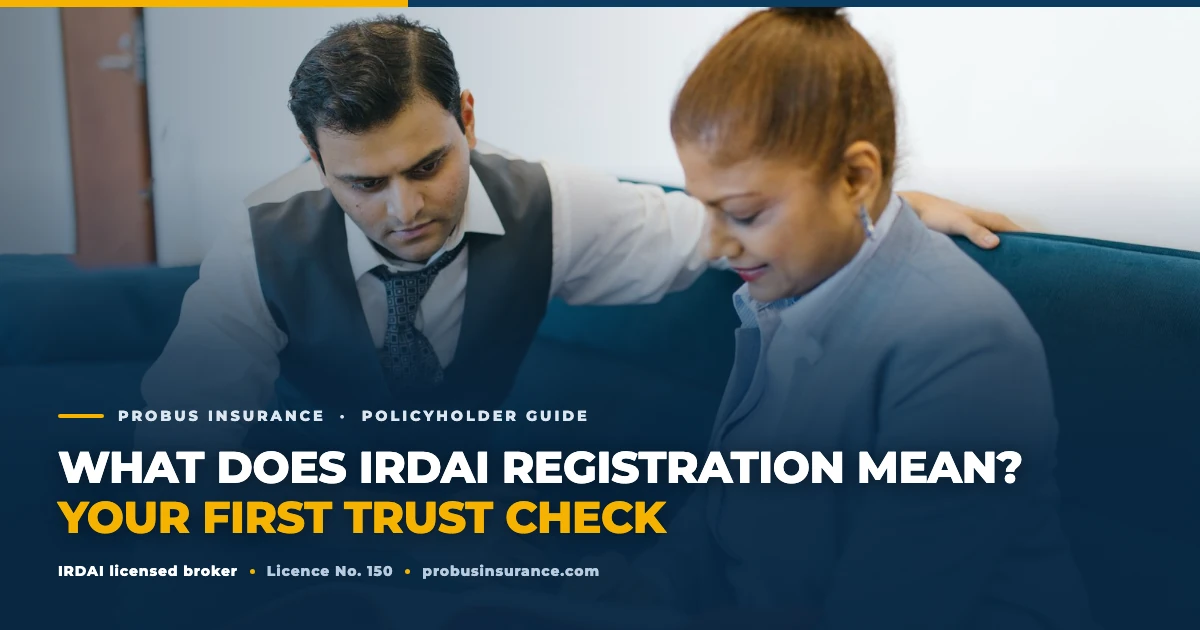
When you buy insurance in India, the first question worth asking is simple: is this company registered with IRDAI? So what does IRDAI registration mean for you as a customer? It means the insurer, broker or agent you are dealing with is authorised to do this work and is supervised by the Insurance Regulatory and Development Authority of India.
That makes registration the first trust check. It is not the only one. This guide explains what registration confirms, why it matters, how to check it in a few minutes, and what to compare next so that the policy you choose also suits you.
Key Takeaways
- IRDAI registration confirms that an insurer or intermediary is authorised and supervised.
- You can check an insurer, a broker and an individual seller in a few minutes.
- After that, compare cover, exclusions, waiting periods and claim support across policies.
- A broker helps with that second step by comparing several insurers for you.
What IRDAI Registration Confirms
IRDAI is the regulator for insurance in India. Every insurer has to be registered with it before it can sell policies, and so does every intermediary, such as an insurance broker, a corporate agent or a web aggregator. Individual sellers, including agents and Point of Sales Persons, work under one of these registered entities after completing the training and examination IRDAI prescribes.
Registration also brings ongoing supervision. Insurers must keep enough capital to meet their obligations and report on it to the regulator. Policies follow IRDAI’s rules on how products are approved and filed. Sellers must follow conduct rules on disclosure and fair selling, which are set out in the published regulations.
Each type of intermediary is registered for a specific role. A corporate agent or an individual agent represents the insurers it is tied to. A broker is registered to act for the customer and can approach several insurers. A web aggregator displays comparisons and passes your details to insurers. Knowing which one you are speaking to tells you what kind of help to expect.
Finally, registration connects you to a defined complaints process. Insurers must run a grievance system with set response times, and the regulator runs the Bima Bharosa complaints portal for policyholders who need to take a complaint further.
Why Registration Matters to You
Put simply, registration tells you that the company in front of you is real, permitted to sell insurance and answerable to a regulator. That is the foundation every other check builds on, and it protects you from one of the most serious risks: paying for cover that does not exist.
It also gives you rights you can use. Most life and health policies come with a free look period during which you can review the document and return it if it does not suit you. Insurers must share key policy information clearly, and you have a clear route to raise a concern if something goes wrong.
Registration also means there is a record. A registered company has a registration number, a registered office and people who are accountable for its conduct. If you ever need to raise a concern, you know exactly who you are raising it with and where it can go next.
For long term cover such as term life or health insurance, this matters even more. You are trusting a company to be there years from now, and the regulator’s supervision of insurer finances is something no individual customer could carry out alone.
How to Check an Insurer, a Broker or a Seller
Checking takes only a few minutes, and it is worth doing before you share personal details or make a payment.
To check an insurer, look for it on the list of registered insurers on the IRDAI website. You can also see the companies Probus works with on its general insurance partner page.
To check a broker, look at the footer of its website or its policy documents for the licence number and category, then confirm the same details on the IRDAI list of registered brokers. Probus, for example, states its registration openly as a Direct Broker (Life and General), Licence No. 150.
To check an individual seller, ask for their name as registered, the company that appointed them and their licence or POSP ID. You can search insurer appointed agents on the IRDAI agency portal, and you can confirm a POSP with the broker or insurer that appointed them, using contact details from that company’s own website.
Finally, pay only to the insurer or through the official payment link of the insurer or broker, and keep the receipt. A premium should never go to a personal account.
!Infographic supporting what does irdai registration mean
What to Compare Once Registration Checks Out
Every registered insurer has met the same entry standard, so registration helps you shortlist rather than choose. Once that first check is done, the next step is to compare the policies themselves.
Start with what is covered and what is excluded. A short read of the common health policy exclusions shows why two plans with similar premiums can behave very differently when you claim.
Then look at waiting periods, sub limits such as room rent caps, and for health cover, whether there are network hospitals near your home. For term cover, check that the sum assured fits your family’s needs and that every question on the proposal form is answered fully.
Ask for the key features document or the policy wording before you pay, and go through it with the person selling to you. A good seller will be glad to point out the limits as well as the benefits, and any question you ask now is one you will not need to ask at claim time.
It also helps to look at how each insurer handles claims and complaints. Insurers publish their claim and grievance figures, and comparing them across a shortlist gives you a practical view of service that registration alone cannot show.
This is a lot to compare on your own, which is where an intermediary who can show you several insurers side by side becomes useful.
Where a Broker Adds Value
An insurance broker is registered with IRDAI to work on behalf of the customer and can place cover with more than one insurer. That changes the conversation from one company’s product list to a comparison built around your needs.
A good broker starts with a needs analysis: who depends on you, what cover you already hold and what you can keep paying. It then compares suitable options, explains the exclusions and waiting periods in plain language, and helps you complete the proposal accurately.
This is most useful when your situation is less straightforward: a family member with a medical history, an older vehicle, a business to protect or a previous claim. In these cases one insurer’s terms may not fit, and a broker can look for another that does.
Support continues after the sale. A broker can send renewal reminders, help with changes to the policy and assist with claim documents and follow up with the insurer, while the claim decision itself stays with the insurer under the policy wording.
How Probus Helps You Choose With Confidence
Probus Insurance Broker is an IRDAI licensed Direct Broker for both life and general insurance. Through Probus you can compare options across family health plans, term life cover, car insurance, two wheeler cover, travel policies and personal accident cover from several insurers.
Probus also publishes the standards it works to. Its code of conduct sets out how its advisors deal with customers, its claim registration page shows how to start a claim with Probus’s assistance, and its ombudsman and grievance page explains the escalation route if you are ever unhappy with an outcome.
So the registration check and the comparison can happen in one place: an IRDAI registered broker you can verify, offering several insurers you can compare.
Conclusion
IRDAI registration is the first trust check when you buy insurance. It confirms that the insurer, broker or seller is authorised and supervised, and it gives you a clear route if something goes wrong. Check it before you pay, then compare cover, exclusions, waiting periods and claim support across a few registered insurers. A registered broker such as Probus can help you do both.
Frequently Asked Questions
It means the insurer or intermediary is authorised by the Insurance Regulatory and Development Authority of India to carry on insurance business and is supervised by it. Individual sellers work under a registered insurer or broker after prescribed training.
Because it confirms you are dealing with a genuine, authorised company before you share personal details or pay a premium. It is the quickest way to avoid fake policies and unauthorised sellers, and it takes only a few minutes.
Look for the company on the list of registered insurers published on the IRDAI website. The insurer’s registration number is also printed on its website and policy documents, so you can match the two before buying anything.
Find the licence number and category in the broker’s website footer or documents, then confirm them on the IRDAI list of registered brokers. Probus, for instance, is a Direct Broker for life and general insurance, Licence No. 150.
Ask for their registered name, appointing company and licence or POSP ID. Agents can be searched on the IRDAI agency portal, and a POSP can be confirmed with the appointing broker or insurer using contact details from its official website.
Registration confirms the company is authorised and supervised, so it is the right place to start. Whether a particular policy suits you depends on its cover, exclusions, waiting periods and your own needs, which is why comparing policies is the next step.
Compare what each policy covers and excludes, waiting periods, sub limits such as room rent caps, network hospitals near you, and each insurer’s published claim and complaint figures. Premium matters, but it is only one part of the picture.
Start with the insurer’s own grievance team, which must respond within set timelines. If the issue is not resolved, you can raise it on IRDAI’s Bima Bharosa portal or approach the Insurance Ombudsman for your area.
A broker works for the customer and can compare policies from several insurers. It assesses your needs, explains exclusions in plain language, helps you fill the proposal correctly and assists with renewals and claim documents later.
Yes. Probus Insurance Broker Private Limited is an IRDAI licensed Direct Broker for life and general insurance, Licence No. 150, Direct Broker code IRDA/DB 106/03. You can confirm this on the IRDAI list of registered brokers.
Probus Insurance Broker Private Limited is an IRDAI licensed Direct Broker (Life and General), Licence No. 150, Direct Broker code IRDA/DB 106/03.